
Alpharetta Directory Runs by Era
The deepest public shelf for Alpharetta research belongs to Fulton County Library System Special Collections. Its metro collection reaches from nineteenth-century alphabetic books into late twentieth-century suburban volumes and twenty-first-century reverse books. The labels matter. A conventional city directory is usually entered by surname. A Haines volume reverses the route, letting a reader start with a street, house number, or telephone number. The suburban run is especially useful for north Fulton places that were not always prominent in older Atlanta-centered volumes.
| Directory collection | Years represented | Research location | How to use it |
|---|---|---|---|
| Atlanta city directories | 1859-1860 through 1991 | Central Library Special Collections | Walk-in alphabetic resident and business listings |
| Atlanta suburban directories | 1953-1986 | Central Library Special Collections | North Fulton and Alpharetta-area coverage |
| Haines Criss-Cross directories | 1946 through 2016-2017 | Central Library Special Collections | Address, street, and telephone routes |
| Released federal census | 1790-1950 | NARA and library databases | Household composition on census day |
| Old Milton local histories | Historical coverage varies | Fulton local history and Alpharetta archive | Families, homes, photographs, and context |
Coverage is not the same as a promise that every Alpharetta address appears in every year. Publication zones changed, some people chose not to list, and a volume may omit an address. The library describes its earliest bound item as 1867 while its broader holdings statement begins in 1859-60, so request the exact year before making a trip. A gap should be carried forward as uncertainty.
Alpharetta Directories at Fulton Library
All of the directory volumes are available for walk-in use at Central Library Special Collections. Questions can be sent to Library.SpecColl@fultoncountyga.gov before a visit. The Alpharetta branch at 10 Park Plaza, 404-613-6735, can help with catalog and database access, but the large directory run is held at Central. Ask staff to confirm the target year, the geographic scope printed in that volume, and whether a reverse section is present.
The Fulton communities research guide also points toward local books, maps, newspapers, and genealogy tools. The Georgia Collection includes census microfilm, Georgia newspapers, old maps, and clipping files. In-library Ancestry Library Edition and other listed genealogy databases can fill a year that the city-directory shelf cannot. Database login rules may change, so confirm access with the library rather than assuming remote use.
The image below comes from the library's Fulton County communities and local-history resource.
Use that library route to connect a directory name with a catalog title, newspaper notice, census schedule, or map while keeping each source's date clear.
Decode an Alpharetta Directory Listing
A directory entry is compressed evidence, not a full life story. Standard books in this collection type may list surname, given name or initials, a spouse in parentheses, an occupation, an employer, and a home address. Business entries can identify a proprietor and premises. In the digitized 1891 Atlanta volume, Polk and Co. used abbreviations such as “r” for residence and “bds” for boarding. The 1902 record names Mutual Publishing Co. as publisher. Those city examples explain the form, but they do not prove that a particular Alpharetta person appeared in the suburban books.
| Printed field | What it may contribute |
|---|---|
| Name and initials | The published spelling for that year; test initials and name variants. |
| Spouse or widow note | A relationship clue that should be checked in vital, probate, or obituary evidence. |
| Occupation or firm | A way to distinguish two people with the same name. |
| Residence or boarding mark | The listed address and the publisher's stated relationship to it. |
| Business premises | A work site, which must not be mistaken for a home address. |
- Criss-cross directory
- A volume organized by street address or phone number rather than only by surname.
- Householder index
- An address-based list that points from a dwelling to the person printed for it.
- Abbreviation key
- The publisher's own legend for short forms. Read it before interpreting any mark.
- Nonlisting
- An omitted name or phone that does not establish the person's absence from Alpharetta.
Historical publications can contain biased language and classifications. Describe that context when needed without repeating harmful labels casually. Most of all, quote the volume, page, year, and publisher. A transcription without its citation is hard to verify later.
Address-First Alpharetta City Directories
The Haines run covers 1946 through 2016-17 and turns an address into a listed occupant or telephone lead. Start with the street as it was known in the target year. Check the number, nearby numbers, and the book's street-change notes. Then use the alphabetic section to expand initials or find an occupation. This two-way pivot is more sound than assuming a modern web listing represents an old household.
Fulton Library says its directory collection also documents street-name changes. That quirk is valuable in Alpharetta, where modern development lies over older roads and subdivisions. If a number no longer maps cleanly, carry the old street wording into plats, deeds, city addressing files, and map research. The Alpharetta street directory is the better route for current parcel and address tools.
Note: Photograph or write down the volume's title page and abbreviation key before copying an Alpharetta entry, because each publisher may use different marks.
Old Milton Names in Alpharetta Records
Alpharetta once served as the seat of Milton County. That county was created in 1857 and merged into Fulton at the start of 1932. An older family, road, or courthouse citation may therefore be cataloged under Milton County even though the modern place is Alpharetta. Search both geographic names in catalogs, newspapers, archive finding aids, and family files.
Two local titles make that bridge explicit: Alpharetta, Milton County: The Early Years by Connie Mashburn, cataloged as GEN R 929.3758 MILTON, and Reflections of the Past: Alpharetta Historic Homes from the Alpharetta Historical Society, cataloged as GA R 929.3758 FULTON. They can add photographs, family context, and house narratives. They are supporting sources, so verify a name or date in the original record whenever possible.
The historical record also contains a conflict. A local account says Union soldiers destroyed county records, while the New Georgia Encyclopedia says those troops did not come closer than the Roswell boundary. Treat the loss story as unresolved unless an archival inventory identifies the missing record group.
Alpharetta's Old Milton Research Archive
The Alpharetta and Old Milton County Historical Society keeps a research archive in the Log Cabin basement at 210 Milton Avenue. Its posted hours are Tuesday and Thursday, 10:30 a.m. to 2:30 p.m., except holidays, or by appointment. Email aomcharchives@gmail.com before a focused visit. The archive describes books, family histories, interviews, subject files, Milton County records, photographs, documents, and newspapers.
Nearly 2,000 photos and documents have been scanned and cataloged internally by fields such as subject, name, date, collection, contributor, and container. Newspaper holdings are selective, not a complete run. Examples include the Milton Democrat from 1884, selected Alpharetta Free Press issues from 1889-1932, North Fulton Herald issues from 1943-1962, and later local titles through 1980.
The following view leads to the Old Milton historical archive and society.
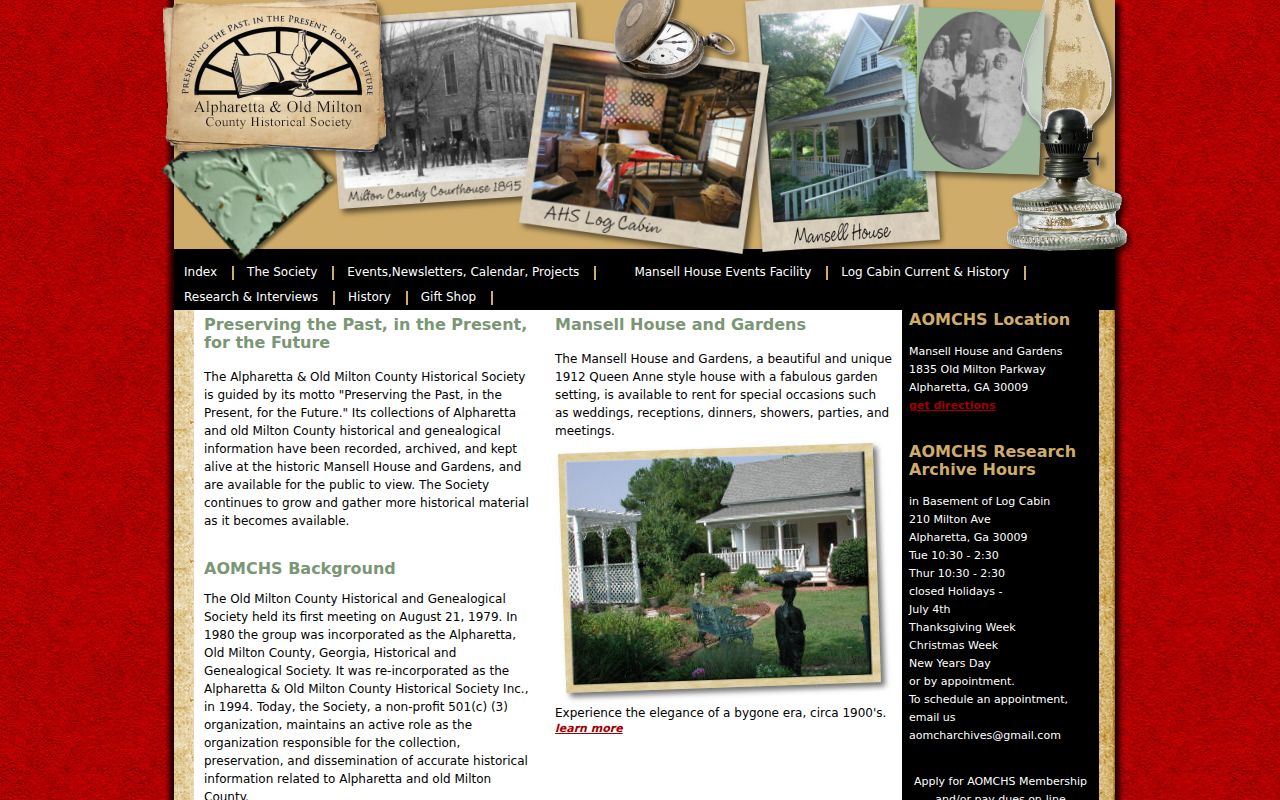
This is the strongest local fallback when an Alpharetta name never appears in the metropolitan city directory run.
Trace Alpharetta Families by Directory
A family trail is strongest when it records both a match and the reason for the match. A middle initial, spouse, occupation, street, and nearby relative can separate namesakes. Follow the record in small date steps and keep ownership distinct from occupancy.
- Establish the historical street name and house number from a deed, family paper, census line, or known directory entry.
- Open the nearest Haines criss-cross year and copy the address listing with its full citation.
- Check the alphabetic city directory for the same name, spouse, occupation, and any move notation.
- Repeat through nearby years. Bracket a change between the last old listing and first new listing without claiming an exact move date.
- Compare entries through 1950 with released census schedules, then test later clues in deeds, probate files, obituaries, and newspapers.
The census gives a household on one enumeration date, while an Alpharetta city directory gives a published listing tied to its own compilation cycle. The newest public population schedule is 1950 under the 72-year release rule. The largely destroyed 1890 census is a national gap caused by the 1921 fire, not evidence of a local Alpharetta courthouse loss.
Georgia Archives Beyond City Directories
When the local shelf ends, the Georgia Archives can help identify state and county government records, catalog entries, and research-room material. NARA Atlanta holds census microfilm, selected military, pension, passenger, naturalization, federal court, and agency records, plus Georgia nonpopulation and mortality schedules. Its Morrow facility operates by appointment on weekdays, with contact available through atlanta.archives@nara.gov or 770-968-2100.
The image below links to the Georgia Archives catalog and research services.
Archive records can explain a boundary, agency, or missing year, but the cited city directory remains the source for what that directory actually printed.